
My wife and I holidayed in Rwanda in 2011. Our main idea was to visit the Virunga National Park and see the mountain gorillas. It was an amazing experience. I wrote a blog and you can read that here. However, before our trip, I had become interested in the genocide of 1994. To learn more, I met up with two genocide survivors, Odette Kayirere and Feza Mediatrice. They changed me forever.
Context. 6th April, 1994. The Rwandan (Hutu President), Juvenal Habyarimana, is returning to Kigali, the capital of Rwanda, on his private jet. He has been in Tanzania signing a peace agreement to end the conflict in his country between Hutu and Tutsi. His supporters are not happy that he signed the deal. Michel, Francois, and Melanie are at a hotel in Kigali.
An unhappy President Juvenal Habyarimana sat in his personal jet as it circled above Kigali airport, returning from negotiations in Dar Es Salaam. The United Nations had twisted his arm a few years ago, and he had signed the Peace Treaty in Arusha, Tanzania, with the RPF. It had not achieved much peace, but he had agreed to sharing power, to democracy, and to having RPF soldiers integrated into the Rwandan army. He allowed himself a snort of derisive laughter when he thought about the farce of the negotiations. He had no intention of honouring the agreement; the plans were already in place for a ‘final solution’ to the ‘Tutsi Problem’.
‘What amuses you, Juvenal?’ asked Cyprien Ntaryamira, President of neighbouring Burundi, whom Habyarimana was giving a lift home. A selection of their senior government ministers chatted in the background.
‘Not enough these days.’
‘What do you have to worry about? This time next year your enemy, the Rwandan Patriotic Front, will be history.’
‘Yes. Of course. But a powerful man must look over his shoulder. The people must know I am strong. When I signed that peace agreement, it looked like I had made a weak compromise. I must act soon.’
‘You will be fine with your French friends to help you. They won’t have the English-speaking Tutsi telling them what to do!’
‘No, they are good allies. They even gave me this jet.’
‘Complete with French pilots. I must make friends with the French government too!’
Both men laughed as Habyarimana looked out of the window at the city below him. Somewhere in the darkness were his palace, his wife Agathe, and their six children. In an hour, he would be sitting in the palace grounds enjoying a glass of wine. Peace at last.
With clearance to land granted, the pilots began to lose altitude in preparation. From the cockpit, the runway of Kigali airport shone the welcome road home. Next, the pilot saw the glaring tail of the rocket streaking into the sky and wondered what it was. Then they noticed it was headed for them. Incredulity was quickly followed by indignation, anger, and finally fear.
There was no time to warn the passengers. There was no point in doing so.
It was significant where the wreckage fell. President Juvenal Habyarimana was at peace in his palace grounds sooner than he planned.
***
At the Kifalme Park Hotel, a large bang and a flash high in the night sky interrupted the mellow poolside atmosphere. Conversation stopped and people looked up in mild surprise. Dozens of guests simultaneously asked one another with variations on the theme of ‘what was that?’ There were further streaks of light and bangs as the wreckage plunged into the city. The stone had been dropped into the pool and, though the waters closed in over it, the ripples quickly began to spread wide and far.
When conversation recommenced, the discussions fell into two camps; those civilians who had no idea what the spectacle was, and those from a military background who knew precisely. Michel and Francois were in the latter camp. They stared briefly at each other. Melanie spoke first.
‘That was no firework.’
‘No,’ replied Francois with a slight frown.
‘It was one of ours, a surface-to-air missile,’ said Michel.
‘A Mistral?’ offered Francois.
‘Sounded like it, but firing at what?’
‘That was not a big plane. A small jet, I’d say, a personal jet.’ Mused Francois, then he looked directly at Michel. ‘And I know of only one person in Kigali with one at his disposal.’
‘Habyarimana!’ whispered Michel. ‘Shit.’
Context:
The assassination of the Hutu President, Juvenal Habyarimana, triggered the start of the Rwandan genocide in 1994. Although Tutsi rebels were blamed, Hutu extremists probably assassinated the president because they believed he had betrayed them.
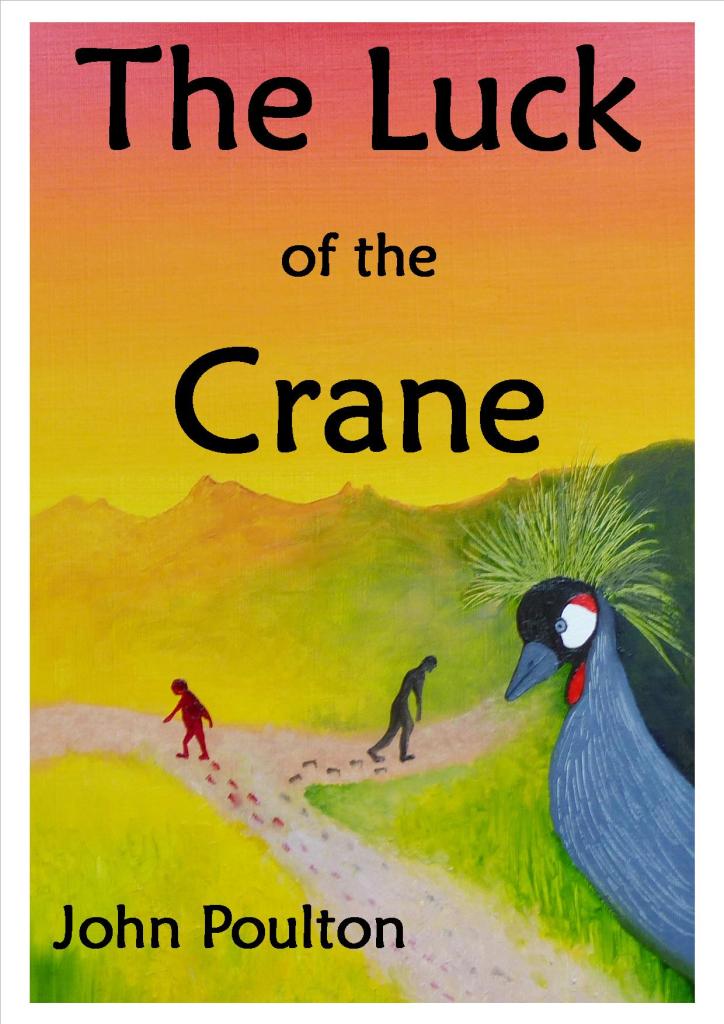
When I came home from Rwanda, I joined a local charity, ‘The Rwanda Group Trust’, as a governor and went on to become its chairman. I worked with them for about five years and visited Rwanda again in that capacity. During this period, whilst walking around the local countryside, the story that would become ‘The Luck of the Crane’ started writing itself in my head. It’s a book about a civil war and a genocide.
I can only pray that I have done justice to the people I met and learned about. Most of the characters in the book are fictitious, but the incidents portrayed are based on historical events.
 John Poulton: Books